Welcome
|
Welcome |
|
JPEGclub.org develops new JPEG features and maintains the Independent JPEG Group's (IJG) software.
The current version is release 10 of 25-Jan-2026. It is a true source reference JPEG codec.
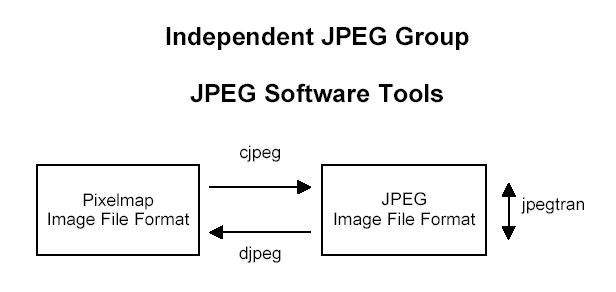
New features and enhancements have been developed for the three major parts of the IJG library: the compression, the decompression, and the transcoding parts. These parts are represented by the three major tools of the IJG software: cjpeg (compress JPEG), djpeg (decompress JPEG), and jpegtran (transcode JPEG - lossless):
A new option has been added to the jpegtran tool and transcoding library:
-scale M/N Scale output image by fraction M/N, eg, 1/8Currently supported scale factors are M/N with all M from 1 to 16, where N is the source DCT size, which is 8 for baseline JPEG. If the /N part is omitted, then M specifies the DCT scaled size to be applied on the given input. For baseline JPEG this is equivalent to M/8 scaling, since the source DCT size for baseline JPEG is 8. CAUTION: An implementation of the JPEG SmartScale extension is required for this feature. SmartScale enabled JPEG is not yet widely implemented, so many decoders will be unable to view a SmartScale extended JPEG file at all.
More about new jpegtran features...
The -scale option of the djpeg tool and decompression library has been extended:
-scale M/N Scale output image by fraction M/N, eg, 1/8Currently supported scale factors are M/N with all M from 1 to 16, where N is the source DCT size, which is 8 for baseline JPEG. If the /N part is omitted, then M specifies the DCT scaled size to be applied on the given input. For baseline JPEG this is equivalent to M/8 scaling, since the source DCT size for baseline JPEG is 8.
More about new djpeg -scale feature...
Two new features have been added to the cjpeg tool and compression library:
    -quality N[,...]   Compression quality (0..100; 5-95 is useful range)
    -scale M/N     Scale image by fraction M/N, eg, 1/2
The -quality option has been extended for support of separate quality settings for luminance and chrominance (or in general, for every provided quantization table slot). This feature is useful for high-quality applications which cannot accept the damage of color data by coarse subsampling settings. You can now easily reduce the color data amount more smoothly with finer control without separate subsampling. The resulting file is fully compliant with standard JPEG decoders.
A new -scale option is provided with cjpeg which complements the corresponding djpeg -scale option. The supported range of scaling factors is 8/N with all N=1...16.
This means you can now easily alter the nominal spatial resolution of a given source image while compressing to JPEG without additional resampling.
For example, if you have an image sensor providing an effective capture resolution of 2268x1512 pixels (HI resolution), you can now directly generate a MED resolution of 1512x1008 pixels (-scale 2/3) and a LOW resolution of 1134x756 pixels (-scale 1/2) from the sensor source resolution with the library while compressing to JPEG without additional resampling.
(An efficient 12x12 FDCT is used in the -scale 2/3 case, and an efficient 16x16 FDCT is used in the -scale 1/2 case instead of the standard 8x8 FDCT inside the library, ensuring high-quality downscaled results - the resulting file is fully compliant with standard JPEG decoders.)
More about new cjpeg features...
The Jpegcrop Windows Application was initially developed to provide a convenient interactive user interface for the new jpegtran -crop feature.
It has now developed to a nearly complete user interface replacement for jpegtran, and furthermore for demonstration of the new djpeg and jpegtran -scale features.jpegcrop.zip
Jpegcrop Windows Application (jpegcrop.exe and jpegcrop.txt), latest release 2026, files in folder.See also the Jpegcrop Preferences and Options description.
J P E G c r o p
News:
- 27-Sep-2021: Unicode support and Preferences modification by Oleg.
- 05-May-2003: The most wanted feature currently for Jpegcrop is a "constrained aspect ratio" crop mode. If you need such a function to crop your photo images to the common 10x15 (3:2) photo frame, have a look at Stefan Scherer's Jpegcrop with FotoFrame feature. This is a preliminary Jpegcrop extension until an 'official' version will be available someday. Thanks to Stefan Scherer for this contribution! See also the lossless rotation apps page for more solutions (jpegtran Frontends "FotoView" from Martin Pola and "JPEGCrops" from Toke Eskildsen).
This software featured by
 programy.net.pl.
Popular software supply in Poland.
programy.net.pl.
Popular software supply in Poland.

 GraphicsFamily.
Nice review with Best Software Award.
GraphicsFamily.
Nice review with Best Software Award.
 Downzen.com.
Comprehensive review with high rating, also in Arabic.
Downzen.com.
Comprehensive review with high rating, also in Arabic.

 Apkmonk Blog.
Comprehensive review.
Apkmonk Blog.
Comprehensive review. KubaDownload.com.
Nice review with Editor's Award.
KubaDownload.com.
Nice review with Editor's Award. MadDownload.
Nice review with Editor's Choice award.
MadDownload.
Nice review with Editor's Choice award.

 Softpedia.
The encyclopedia of free software downloads.
Softpedia.
The encyclopedia of free software downloads. Pandia.
Nice overview and review.
Pandia.
Nice overview and review. Programosy.pl.
Popular software supply in Poland.
Programosy.pl.
Popular software supply in Poland. Instalki.pl.
Popular technology website in Poland.
Instalki.pl.
Popular technology website in Poland. FindMySoft.
With nice Quick Look Video and
review.
FindMySoft.
With nice Quick Look Video and
review.

 SoftSea.
 SnapFiles.
 FamousWhy.
With nice tutorial
and interesting
interview.
FamousWhy.
With nice tutorial
and interesting
interview.

 Fiberdownload.
Presentation with review.
Fiberdownload.
Presentation with review.

 BrotherSoft.
 Softoxi.
With nice Video Tutorial and
review.
Softoxi.
With nice Video Tutorial and
review.

 RoxySoft.
 PC Magazine.
 T.H.E
Journal.
T.H.E
Journal. About Graphics Software.
 CoMa's
Freeware List.
CoMa's
Freeware List. Freeware World Team.